
Washington Parish Court Calendars Explained
The 22nd Judicial District Court calendar posts three items. These are an annual calendar, a duty-judge calendar, and a holiday schedule. For Washington Parish, the annual version covers felony jury-trial weeks, civil jury and bench trial weeks, traffic court, misdemeanors, juvenile matters, felony motions, child support, Drug Court, civil motions, civil pretrials, felony pretrials, family matters, and arraignments. These blocks describe sessions. They are not a public roll of every party scheduled that day.
The 22nd JDC's Other Courts page puts it plainly. The calendar gives matter type and location, and case-specific information sits with the Clerk website. Docket information for a given day is unavailable online, per that same notice. So treat the annual calendar as a map of the court's schedule. Confirm an individual setting through the Clerk. You can also check the assigned division, or a case record within reach.
Washington Parish Court Calendar Layers
Each calendar link answers a different question. The annual calendar lays out court weeks and session types. Duty assignments come from the duty-judge calendar. Expected closures come from the holiday schedule. None of the three replaces the case docket, a filed order, or a direct confirmation of a hearing. Even a date visible in one layer may need the Clerk or division before the case-specific time and status are settled.
| Official calendar material | What it helps identify | What it does not establish |
|---|---|---|
| Annual court calendar | Session type, parish, division, and scheduled court period | Every individual case heard during the session |
| Duty-judge calendar | Duty assignment for the listed period | The full event history of a particular case |
| Holiday schedule | Planned court closures and dates to recheck | The replacement setting for an affected case |
| Clerk docket record | Available public case events and documents | A guarantee that every restricted document is open online |
The official calendar landing page brings those materials together.
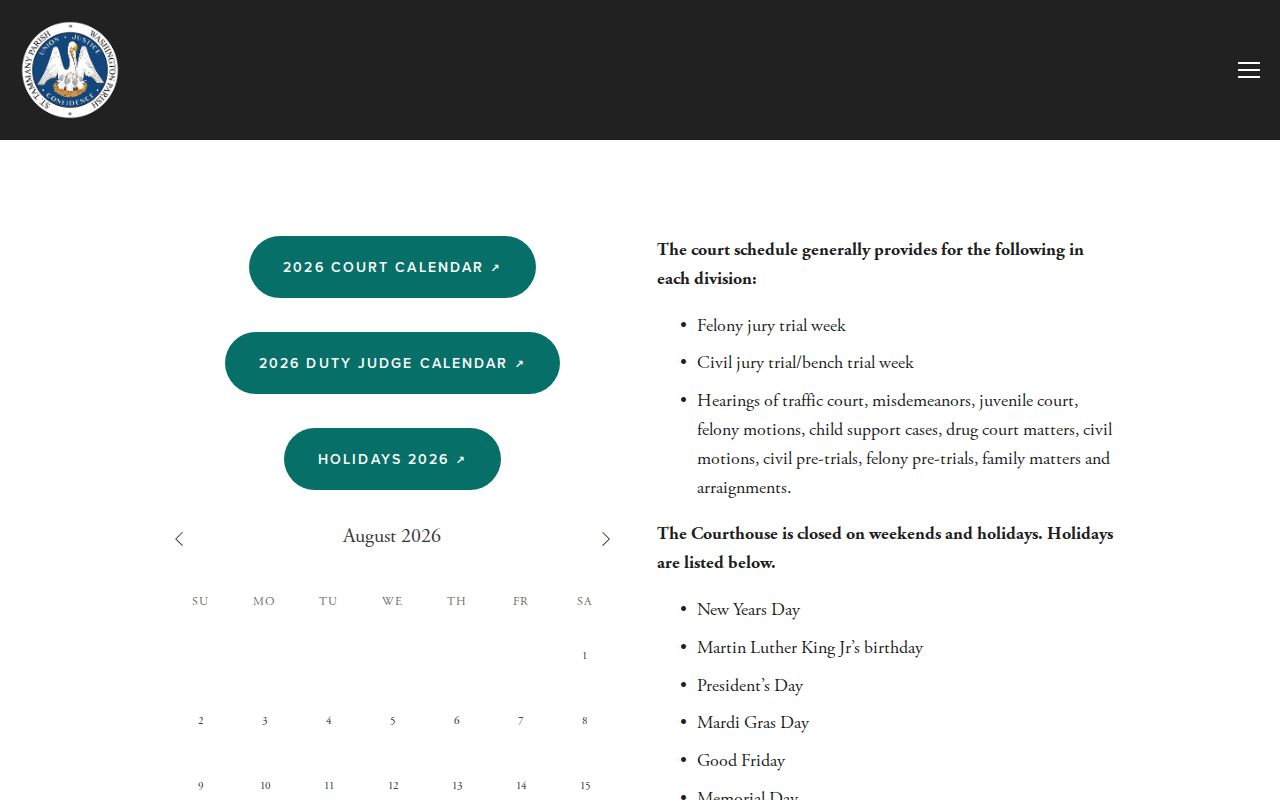
The calendar links are a fine first stop for court dates. A case-specific question still belongs with the Clerk or the court division.
Finding Your Court Date
Begin with the 22nd JDC calendar for the public session schedule. Collect the docket number and division if you have them. The Clerk's direct line is 985-839-4663. Walk-in service happens at 908-B Washington Street in Franklinton. Written requests go to the Custodian of Records. The paid Cott eSearch covers available Clerk index and image material. Its pre-login screen does not display the detailed case fields behind the login.
Municipal citations and ordinance matters belong with the court that issued them. That may be Bogalusa City Court or Franklinton Mayor's Court. A federal case lives in PACER and the Eastern District of Louisiana. It does not sit in the Washington Parish Clerk index. For family, juvenile, protective-order, or specialty settings, say so up front. The general-division calendar alone may not carry that detail.
- Check the 22nd JDC calendar for the scheduled session type, date, and Washington Parish location.
- Use the docket number, division, and case type to ask the Clerk or division for the individual setting.
- Use paid Cott eSearch for available case-record information, remembering that calendar and docket serve different purposes.
- Contact the issuing municipal court for a municipal citation or ordinance matter, or PACER for a federal case.
- Ask whether a listed date is a reset, continuance, duty-judge change, or cancellation before relying on it.
Washington Parish Court Setting Labels
Labels in the annual materials include WP-CIVIL, WP-REV, WP-MOTIONS, WP-LWOP PRETRIAL, WP-CRIM SPECIAL SETTING, WP-MISD ARRAIGN, WP-REVOCATION / ARRAIGNMENTS, and WP-FEL ARR/REV/PDO PT. Each one marks a kind of proceeding or calendar block. It says nothing about the facts, the filings, or the result in any single case.
- WP-FEL ARR/REV/PDO PT
- A Washington felony arraignment, revocation, or related pretrial label; confirm the precise case event with the Clerk or division.
- WP-MISD ARRAIGN
- A Washington misdemeanor arraignment session label, not a disposition or final court result.
- WP-CIVIL
- A civil session label that indicates the calendar category but not every case listed within it.
- WP-REV
- A review setting, which does not by itself mean a case is concluded.
Labels work best beside a docket number, a division, and a rough date. Without those, ask for confirmation instead of guessing what happened.
How to Read a Court Setting
A public calendar setting usually pairs a date with time, parish or location, division, judge or duty-judge detail, and a setting type. The division or location can matter as much as the date itself. A session block may fit the court's schedule neatly while saying nothing about your matter. Is it first on the call, continued, or set for a stated time? The calendar will not tell you.
| Date | The listed court day. Verify it again if a closure, reset, or order may have changed it. |
|---|---|
| Time | The published session or docket-call time, which may not be an individual hearing time. |
| Parish or location | The calendar’s Washington Parish location information; confirm the room or courtroom when needed. |
| Division or judge | The assigned division or duty-judge context used to route a setting question. |
| Setting type | A category such as arraignment, motion, pretrial, trial week, or family matter. |
Treat a calendar entry as a prompt to verify. It is no stand-in for the court's current instructions in a specific case.
Washington Parish Court Date Location
Misdemeanor sessions for Washington Parish take place at the Washington Parish Courthouse. They run at least three times a month. The room is not fixed. A lobby sign or a bailiff usually points the way on the day you arrive. If your court date lists no room, that is a scheduling detail, not a cancellation. The hearing is still set, so follow the posted instructions at the courthouse.
When the room assignment stays unclear, call the Clerk. The 22nd JDC handles these sessions. Its Washington contact information gives the courthouse location plus the Clerk's phone route in one place. Anyone with a misdemeanor case number can use that page to confirm where to go before leaving home.
Need a quick official reference? The 22nd JDC Washington contact page lists the court's current contact details for local docket questions.
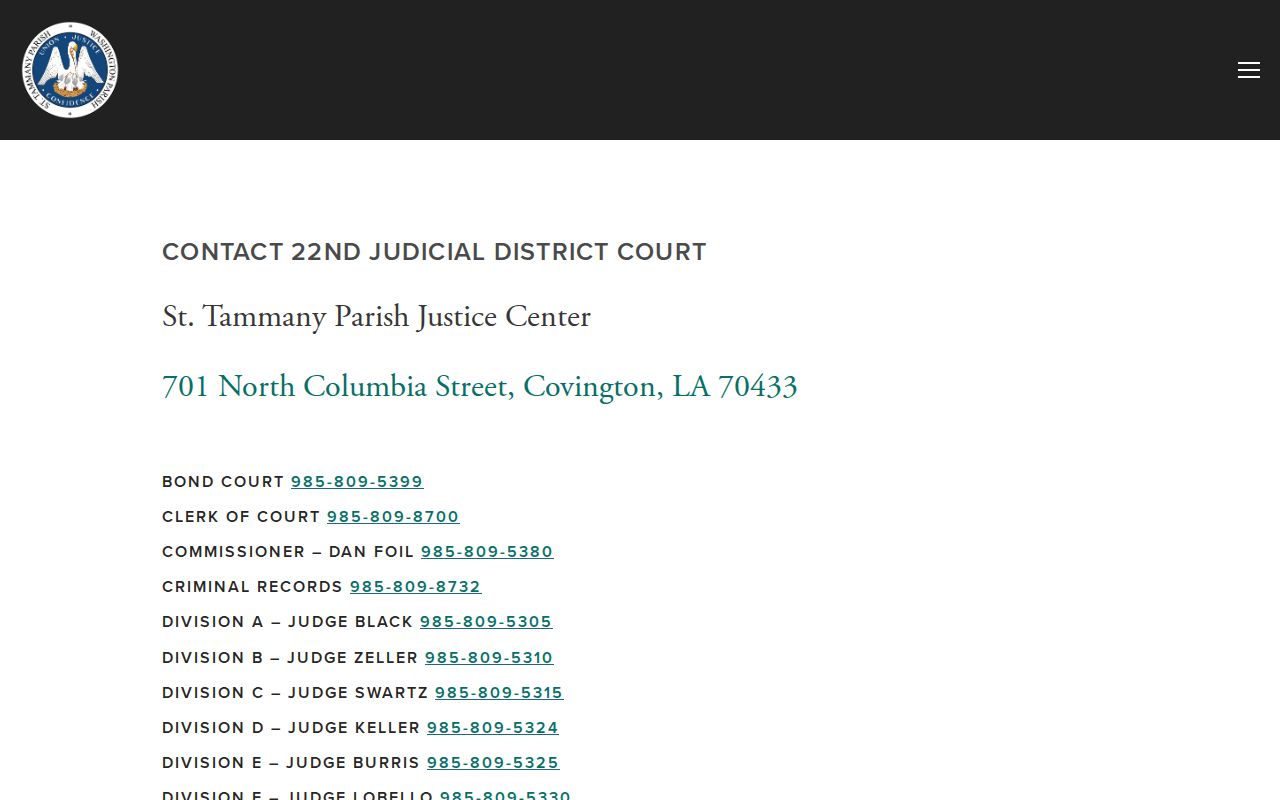
That contact route earns its keep when a setting lists a date and division but leaves the room or appearance instruction unclear.
Continuances, Resets, and Cancellations
Resets, continuances, and cancellations each mean something a bit different on a Washington Parish court docket. A reset shifts a setting to a new date. A continuance postpones a proceeding. A cancellation may follow a closure, an order, or a revised court schedule. None of these events decides the case itself. A blank on an online calendar never proves a dismissal. An older calendar copy can also miss the replacement setting that followed.
Before assuming anything, ask the Clerk or the division handling the matter. Ask which one occurred: a reset, a continuance, a duty-judge change, or a cancellation. Have the docket number and division handy if you know them. For any single case, the current docket, notice, or order beats an annual calendar every time.
Washington Parish Court Closure Order
One Washington Parish order shows why a court date needs rechecking after any closure. On January 17, 2025, the court issued an amended inclement-weather order. It shut the courthouse and Clerk for January 21 and 22 because of hazardous conditions. Civil, domestic, juvenile, child-support, and protective matters were reset with notice. Criminal, bond, and misdemeanor defendants got separate re-service instructions. Specialty court was canceled for that period.
So a closure can hit each case type differently. The amended weather order shows one real access event, not a forecast of later closures. For the replacement date, rely on the current calendar. Clerk notices and whatever instructions apply to your case matter too.
If You Miss a Court Setting
Start by verifying the setting and case type. The Clerk of Court or the assigned division can confirm what was scheduled and when. Give them the docket number, the division, and the date you expected. Keep in mind that a calendar entry may show a session block rather than instructions for each person, and a recent reset or closure can change what is currently required. If you have an attorney, follow that attorney's current case instructions as well.
Act promptly. Do not assume a missing date was canceled or that a court will automatically issue a new setting. Ask the Clerk or division for the current record and follow the instructions or order that applies to the particular case.
A court clerk can explain record and scheduling details but cannot give legal advice. When the fallout from a missed setting is unclear, talk to a licensed attorney. That advice has to be specific to your matter.
Washington Parish Court Date Changes
When a Washington Parish court date seems to have moved, three layers help you pin it down. The calendar shows the court's general session. Cott eSearch can supply available case index and image information through a paid Clerk account. The Clerk's direct record route goes to the case file itself. It can confirm an order, notice, or later setting. Each layer answers part of the question. The Clerk is the legal custodian of court files under La. C.C.P. art. 251. Louisiana's public-record rules support access. But confidentiality laws and court orders can still limit specific information.
Ask for the smallest item that settles it. For a date question, that means the current setting, the applicable division, and the document or notice recording any change. Rather than a broad description, hand the Clerk the useful facts. That means the case type, docket number, division, the date first expected, and whether your question is about a hearing, a document, or a replacement date. The calendar route works best for court-wide scheduling. A record request fits better when the answer depends on a filed notice. It also fits a case-specific order. Those details keep a court docket inquiry pointed at the source that can actually answer it.
Finally, note the date you confirmed and the office or division you contacted. If later calendar material conflicts, repeat the focused inquiry. Resist trying to reconcile separate session labels without the case record in hand.