
Searching Washington Parish Criminal Dockets
Most people begin with the Washington Parish Clerk Cott eSearch. It is not a free guest case search. Access requires a paid account with a User ID and password. The criminal search filters only appear after login. Assume nothing about name, docket-number, date, or document filters until the account is live. The Clerk's Criminal Department also handles misdemeanor, felony, expungement, traffic, and criminal-search services.
Good identifiers make any docket search easier. Bring the docket number if you have it. Add the division, the name as written in court papers, an approximate filing year, and the event or document sought. A calendar label is not a case number. If the portal does not help, take the question straight to Washington Parish Clerk of Court Johnny D. Crain, Jr. Call 985-839-4663, visit the counter at 908-B Washington Street in Franklinton, or send a written request to the records custodian.
- Identify the case as criminal and gather the name, division, approximate year, or docket number.
- Use the paid Cott eSearch account for available criminal index entries and images.
- Compare a calendar setting with the Clerk record instead of treating the calendar as a full case history.
- Call or visit the Clerk when a result is unclear, absent, older, or needs an official copy.
- State whether the request concerns an index entry, a date, a document image, or a certified record.
Washington Parish Criminal Cott Access
Cott eSearch sells subscriptions in four tiers: 24 hours for $20, one month for $75, six months for $400, and one year for $750. Printing runs $1 per page. Those are portal terms only. Not every court document sits online, and the terms warn that indexing, verification, and release can lag. A zero result may reflect timing or a record limitation, not the final answer on a case.
The Clerk's online-services page also covers new criminal filings, pointing to CottFile e-filing or a walk-in route. Keep the two straight. CottFile accepts documents for filing. Cott eSearch is the paid research path for a docket lookup.
For the office function behind both channels, look here. The Clerk's Criminal Department description lays out what the department handles.
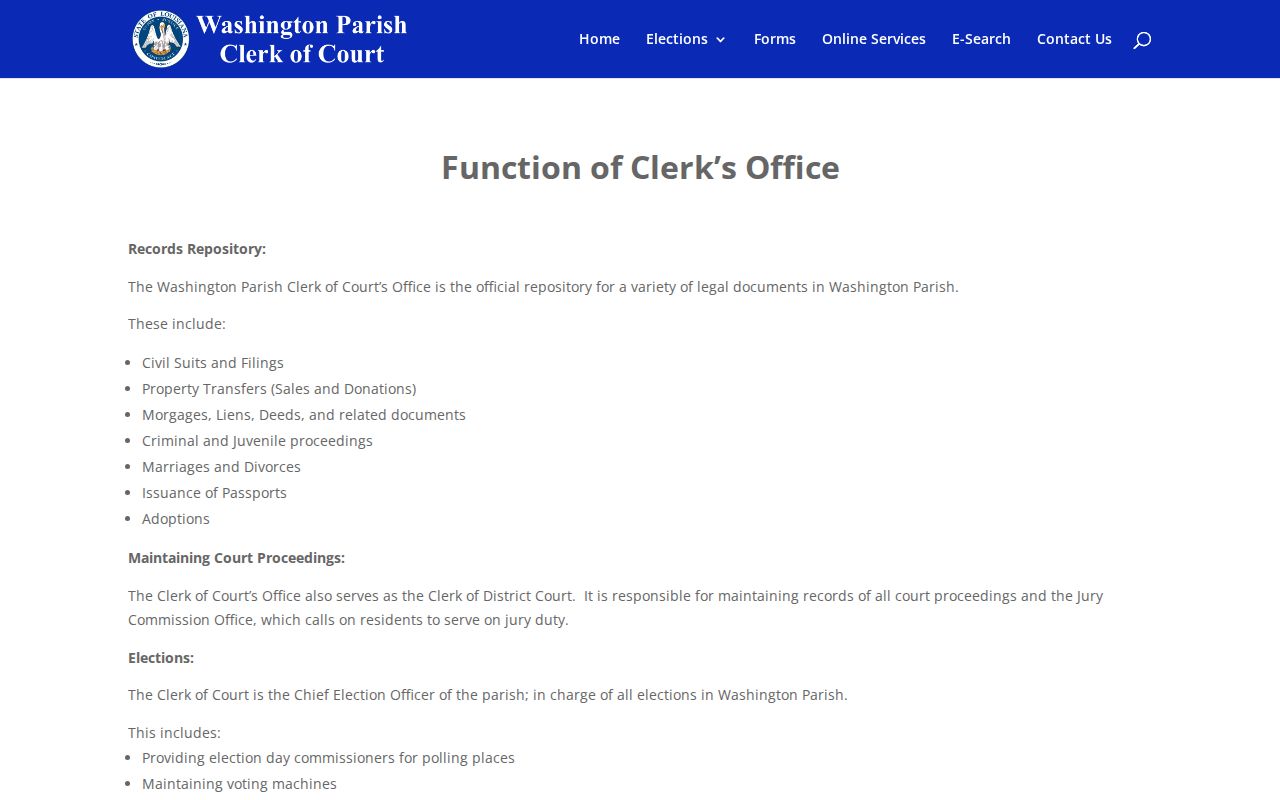
The department listing helps you pick the right lane before contacting the Clerk. Choose among a criminal search, expungement, traffic, or filing request.
Inside a Washington Parish Criminal Docket
A criminal docket is an event record, not the whole case file. When indexed and public, it can show a lot. The entries include a docket number, division, filing date, charge or statute description, arraignment or pretrial setting, motions, a plea or trial event, disposition, and sentencing. The complete file may also hold orders and minute entries. It may also hold exhibits and service documents. Those never appear in a calendar line or an available image.
The 22nd JDC calendar uses session labels like WP-MISD ARRAIGN or WP-CRIM SPECIAL SETTING. A label names the scheduled block and nothing more. It does not prove a final result for every matter set in that block.
| Docket number | The Clerk’s case identifier; use it with the division when asking for a specific record. |
|---|---|
| Division | The assigned court division, which helps distinguish local criminal settings and records. |
| Charge or event | A public charge description or an event such as arraignment, motion, plea, trial, or sentencing. |
| Setting | A scheduled court event, which can move without deciding the case. |
| Disposition | A recorded outcome when public; verify it in the docket or an order rather than from a calendar label. |
Washington Parish Criminal Image Dates
The Cott availability panel lists criminal images from July 1, 2015 through current, subject to indexing and release. Treat that as the online-image starting point. It is not the first date the Clerk holds criminal paper records. An older case may need a direct Clerk search. That applies even when the portal returns no image. The same caution applies when an index entry shows but the image does not.
An empty result calls for a practical response. Check the approximate filing date and record group, ask whether the matter is restricted or not yet indexed, then use the Clerk's counter, phone, or written custodian request. A missing image never means the criminal case failed to exist or that a docket entry was removed.
How a Criminal Case Moves
Washington Parish calendar terms suggest a general sequence, though every case moves its own way. A case may start with a filing or charge. After that come arraignment, pretrial work, a motion or special setting, plea or trial, disposition, and sentencing. Revocation and post-conviction events can follow. When entries are combined, moved, or left off an online display, the court docket or order in the individual case controls.
Docket flow: Filing or Charge → Arraignment → Pretrial → Motion or Special Setting → Plea or Trial → Disposition → Sentencing
Bond Court and specialty programs can generate recurring dates tied to the underlying criminal case. The 22nd JDC says Bond Court began in 2001 and expanded in 2018 through a grant to track drug-testing conditions of bond. It is not a separate public party-case index.
Washington Parish Criminal Calendar Labels
The 22nd JDC calendar relies on local labels such as WP-MISD ARRAIGN, WP-CRIM SPECIAL SETTING, WP-REVOCATION / ARRAIGNMENTS, and WP-FEL ARR/REV/PDO PT. They tell you the kind of session set for a date. They do not list every case in that session or replace the Clerk's case record.
- WP-MISD ARRAIGN
- A Washington Parish misdemeanor arraignment setting block, not a complete case outcome.
- WP-CRIM SPECIAL SETTING
- A special criminal setting whose case-specific purpose should be confirmed with the Clerk or division.
- WP-REVOCATION / ARRAIGNMENTS
- A calendar block that can cover revocation or arraignment activity; the underlying docket identifies the event in a case.
The Louisiana Supreme Court's Charge Code Search explains a statute, ordinance, or court-cost category. It cannot find a Washington Parish party case by ticket number.
Courts That Hold Criminal Dockets
Felony cases in Washington Parish go to the 22nd Judicial District Court of Louisiana. Local rules spread them across the general divisions by rotation. Misdemeanors are different. The parish runs a single misdemeanor docket. Any general division can hear non-jury misdemeanor matters, and cases with a jury right follow the same allotment pattern as felonies. The division letter is worth having when you search. But it won't hand you one tidy parish-wide criminal docket list.
Appeals take a separate path through the Louisiana First Circuit Court of Appeal. The appeal gets its own filings and docket number. Questions belong with that court or the right Clerk. They do not belong with a Washington Parish trial setting.
To see Division E in action, the court posts official Judge Burris and Division E information, and the full division structure appears in the 22nd JDC local rules.
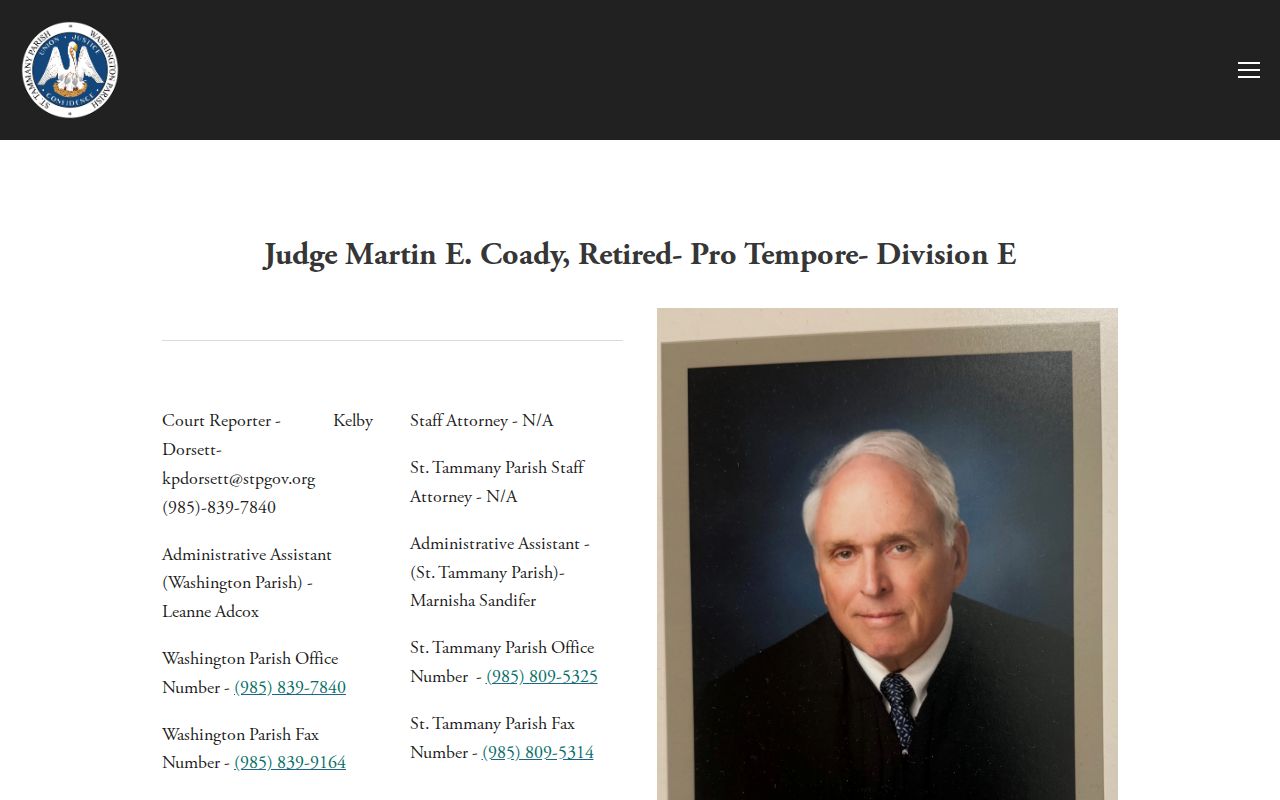
Knowing the division lets a requester line up a case number or calendar entry with the assignment shown on the court record. That match is what makes a docket search useful.
Washington Parish Misdemeanor Docket
Washington misdemeanor sessions run at the Washington Parish Courthouse. They meet at least three times a month, per the 22nd JDC's Other Courts information. The room shifts when other sessions need the space. A lobby sign or a bailiff will point you to the right place, so check those instructions and confirm with the Clerk if you have a date but no room. An old calendar copy is not a reliable guide.
A moving room doesn't change anything about the case itself. The calendar shows matter type and location. The court states that detailed docket information for a given day is not available online. For a specific misdemeanor case, the Clerk's record channel is the next stop.
The court's Washington misdemeanor-court notice shows the local practice of directing attendees to the room on site.
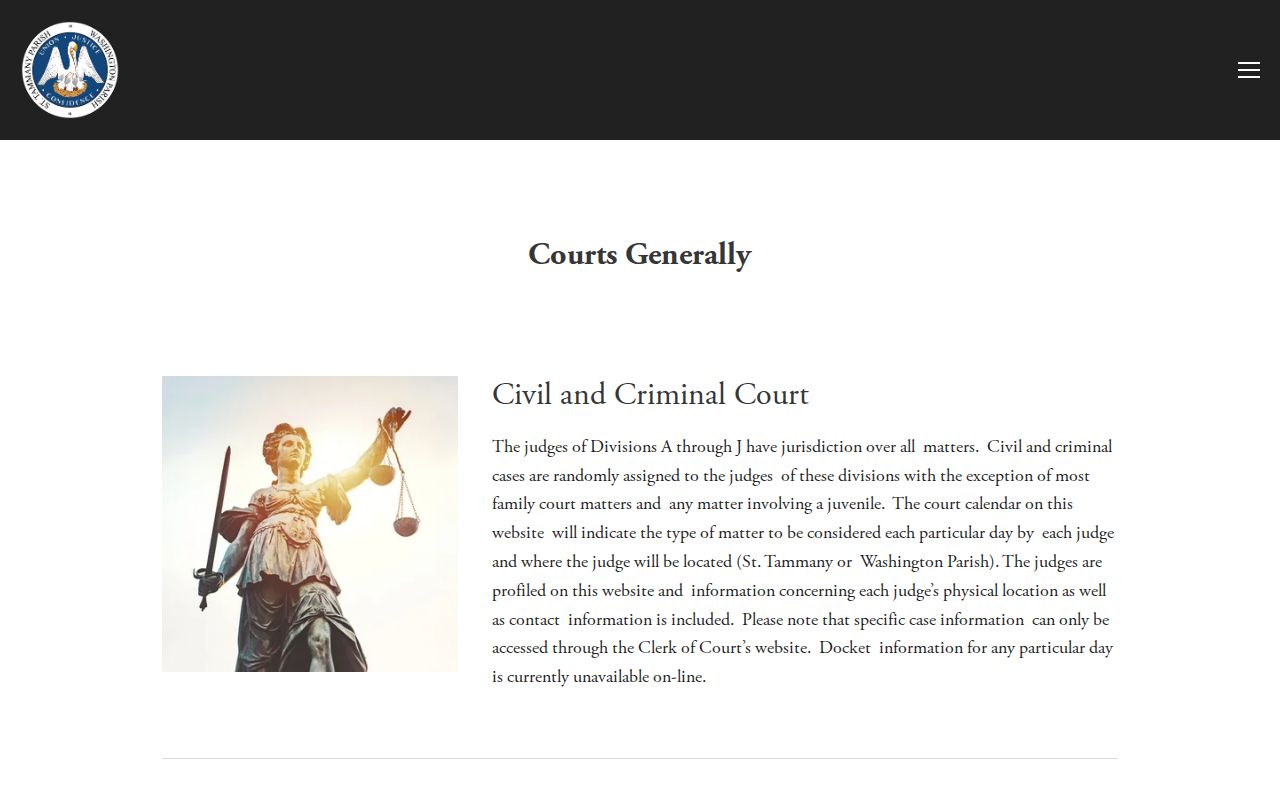
When a listed misdemeanor session gives no fixed room, the official notice points to the lobby sign or the bailiff. That on-site step settles what the calendar leaves open.
Sealed Dockets and Public Access
Louisiana's public-record rules don't open every court item. The Louisiana Public Records Law defines what counts as a public record. It also grants a right to inspect and copy. For court files specifically, La. C.C.P. art. 251 names the clerk as legal custodian and covers examination and copies. Confidentiality statutes, redaction, and court orders still apply on top of all this.
Some doors stay shut. Juvenile proceedings and records are confidential under Children's Code art. 412. An adult criminal docket search can't reach them. Expungement works differently. La. C.C.P. art. 971 removes a criminal record from public view without destroying it. A search that comes back empty is not proof that nothing ever happened.
Access rules matter. The Clerk can explain whether a particular public record is available, whether an image is restricted, and whether a request needs a more specific description. A sealed exhibit, protected data, or juvenile matter may not be available through an ordinary public lookup.
Washington Parish Criminal Filing Context
How busy is this court? The Louisiana Supreme Court's 2025 annual report counts 1,568 Washington Parish criminal filings in 2025. That's up from 1,255 in 2024. Criminal jury trials numbered 13 in 2025 and 11 in 2024. These are totals, not statements about anyone's case. They do explain why the calendar splits arraignments, pretrials, motions, revocations, and trial blocks into separate hearing types.
A docket helps you track a known matter, check a setting, or ask the Clerk for the record itself. It won't answer everything. Questions that turn on a missing document, a restricted case, or a later court order need more than public docket information.